
The Attention Economy and the Collapse of Cognitive Autonomy
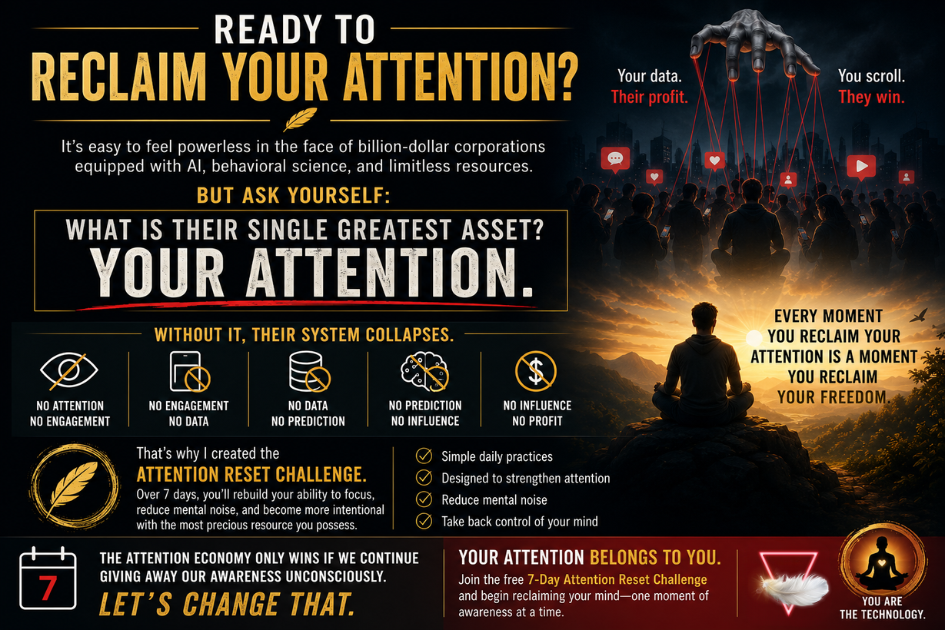
The attention economy generates well over $700 billion each year.
Behind this staggering figure is an ever-expanding machine that never sleeps. Every second of every day, billions of people unknowingly contribute to its operation. Remarkably, its most productive workers are never hired, never trained, and never paid.
They are us.
The Most Valuable Resource on Earth
For most of human history, wealth was measured in land, labor, energy, or raw materials.
Today, one of the world's most valuable resources is something far less visible:
Human attention.
The attention economy is an economic model that treats our capacity to focus as a scarce and finite commodity. Digital platforms compete relentlessly to capture, retain, and monetize that resource, converting our time, clicks, views, and engagement into financial profit.
At first glance, this may seem like a harmless exchange. After all, many of these services are free.
But they are not truly free.
When a product costs nothing, it is worth asking what is actually being exchanged.
In many cases, the answer is simple:
Your attention is the price.
Why Attention Became the World's Most Valuable Currency
The idea behind the attention economy is rooted in a fundamental economic principle.
Information is abundant.
Attention is not.
Every day, humanity produces more information than any individual could consume in a lifetime. Yet the human brain has not evolved to process limitless amounts of information. Our ability to focus remains remarkably limited.
Scarcity creates value.
As information became effectively infinite, attention became increasingly precious.
Technology companies quickly realized that whoever captures attention also gains access to something even more valuable: human behavior.
How the System Works
The process is surprisingly straightforward.
The "Free" Exchange
Social media platforms, search engines, streaming services, and countless apps offer their products at little or no financial cost.
Instead of paying with money, users pay with time, focus, and engagement.
Data Collection
Every click.
Every pause.
Every search.
Every video you finish.
Every post you ignore.
Every second you linger over an image.
All of it becomes behavioral data.
Over time, these tiny signals accumulate into remarkably detailed psychological profiles.
Algorithmic Curation
Using this information, algorithms continuously personalize your experience.
The objective is not necessarily to show you the most truthful, meaningful, or beneficial content.
The objective is to maximize engagement.
The longer you remain on the platform, the more opportunities exist to collect data and present advertising.
Monetization
Armed with increasingly accurate behavioral models, advertisers can place highly targeted messages before the people most likely to respond.
The result is one of the most profitable business models ever created.
But Attention Isn't the Final Product
Many people assume that technology companies are selling our attention.
In reality, attention is only the doorway.
The true product is predictability.
Every moment of attention generates behavioral data.
Behavioral data trains increasingly sophisticated prediction models.
Prediction models make it possible to influence future behavior.
Behavior produces profit.
The cycle becomes self-reinforcing:
Attention → Data → Prediction → Influence → Behavior → Profit
The more accurately human behavior can be predicted, the more valuable that prediction becomes.
The economic incentive is therefore not merely to understand us, but to become increasingly effective at shaping the environments in which our decisions are made.
Designed to Keep Us Inside the Loop
To sustain this cycle, platforms employ countless design strategies that encourage continued engagement.
Push notifications interrupt daily life precisely when attention begins drifting elsewhere.
Infinite scrolling removes natural stopping points.
Autoplay eliminates moments of conscious choice.
Recommendation systems continuously present content calibrated to maintain curiosity, emotional activation, or novelty.
None of these features exist accidentally.
They are carefully refined through continuous experimentation because even tiny increases in engagement translate into enormous financial returns.
The Real Question
Public discussions often ask whether corporations should have the right to manipulate human attention.
In practice, that debate is largely behind us.
These systems already influence billions of people every day.
The more important question is this:
Are we willing to surrender the authorship of our own minds?
This is no longer simply a conversation about social media.
It is a conversation about cognitive sovereignty.
The Collapse of Cognitive Autonomy
The consequences extend far beyond excessive screen time.
When our attention becomes increasingly fragmented, so does our capacity for sustained reasoning.
Reflection becomes more difficult.
Deep reading becomes rare.
Emotional reactivity increases.
Complex issues are replaced by simplistic narratives.
Novelty begins to dominate wisdom.
At the individual level, this may appear as distraction, anxiety, shortened attention spans, or compulsive technology use.
Collectively, however, these effects accumulate.
As individual cognitive harms spread across society, they gradually erode shared understanding, mutual trust, and thoughtful public discourse.
Polarization intensifies.
Misinformation spreads more easily.
Democratic deliberation becomes increasingly fragile.
The deterioration of individual cognitive autonomy eventually becomes a collective crisis.
Civilizations rarely collapse because people suddenly stop thinking.
More often, they decline because people gradually lose the ability to choose what they think about.
The Missing Education
Every civilization teaches children how to read.
How to write.
How to calculate.
How to use technology.
Yet almost none teach the skill upon which every other ability depends:
How to consciously direct attention.
We spend years learning how to operate computers, smartphones, software, and artificial intelligence.
Very few of us ever learn how to operate our own minds.
Perhaps this is the greatest educational omission of our time.
The Path Forward
The solution is not to reject technology.
Technology itself is morally neutral.
It can distract us.
It can educate us.
It can manipulate us.
It can awaken us.
The determining factor is not the technology.
It is the consciousness of the person using it.
Humanity does not merely need better digital tools.
It needs greater cognitive literacy.
We must learn to recognize when our attention is being captured, understand the psychological mechanisms involved, and deliberately cultivate the capacity to direct awareness rather than surrender it.
Practices such as meditation, contemplative reading, reflective writing, intentional silence, and sustained concentration are no longer luxuries reserved for spiritual traditions.
They are becoming essential technologies for preserving human freedom.
A New Definition of Freedom
Freedom is often understood as the ability to do whatever we want.
Perhaps a more accurate definition is this:
Freedom is the ability to choose where our attention goes.
Every perception...
Every memory...
Every emotion...
Every decision...
Every habit...
Every identity...
Begins with attention.
Attention is not merely another cognitive skill.
It is the master interface of human consciousness.
Whoever governs attention ultimately governs perception.
Whoever governs perception influences reality.
The future of human freedom may depend less on the intelligence of our machines than on whether we remain capable of directing the one technology that has always mattered most:
Our own mind.
🜃
Your attention built the attention economy.
Now let it build you instead.
